
Watch the webinar: The rise of lone worker satellite communications for safety-critical industries
Trackplot joined Globalstar and IOSH Magazine hosting a webinar for IOSH members to discuss the rise of lone worker satellite communications.
With a focus on lone worker satellite communications, the panel explored the challenges, risks and solutions for keeping lone workers safe across industries such as utilities, construction, land based industries including agriculture, fisheries, forestry, estate management and conservation, and government, where more employees are working in isolation or in remote environments where connectivity isn’t guaranteed.
The panel members were Emma Thomas, Commercial Director at Trackplot, Mark O’Connell, General Manager for EMEA & APAC at Globalstar, and Dr Chris Davis, Thought Leadership Manager at IOSH (Institution of Occupational Safety and Health) and the webinar was hosted by Kellie Williams, Digital Editor at IOSH Magazine.
Watch the webinar
Duration: 1 hour
Takeaway points from the webinar
Why lone worker safety is a growing concern
- More organisations are deploying field-based teams in very remote areas.
- The societal shift to hybrid working, labour shortages and increasing costs all contribute to making lone working more common.
- Growing legislation across Europe and beyond.
- Increased focus on the employer’s duty of care and the reputational risk of failing that duty of care.
- When a worker is isolated and something goes wrong, how do they raise the alarm? Without reliable communication, help can’t get there in time.
- Lone worker incidents can halt operations, not just endanger lives.
64% of UK organisations have experienced a lone worker incident in the past three years.
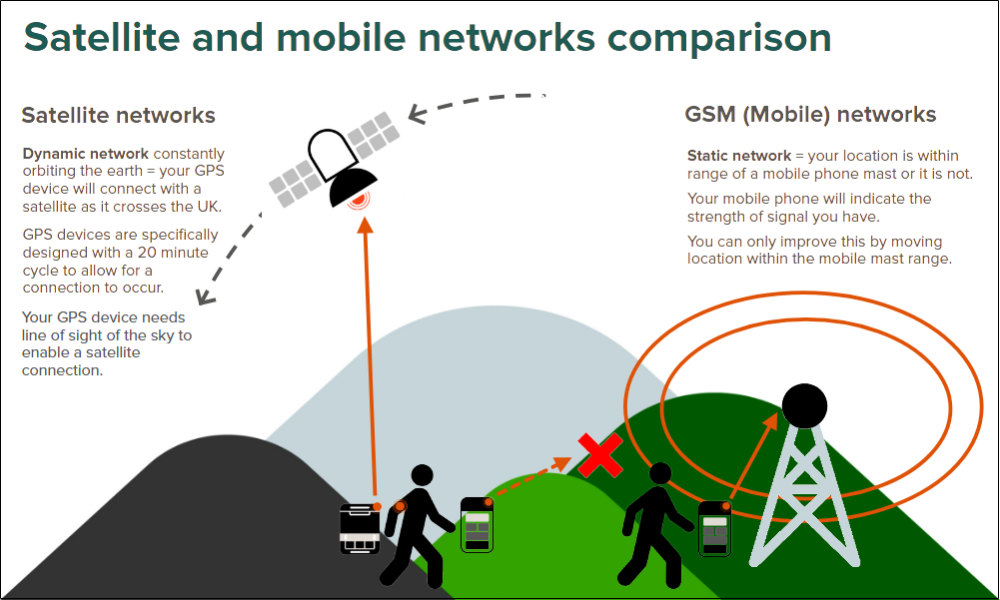
Coverage gaps in GSM (Global System for Mobile communications) networks
- GSM coverage is designed for population centres, not remote operations.
- There are still significant GSM blind spots where workers are effectively invisible.
- GSM dead zones include difficult environments such as mountainous terrain, dense forests and onshore energy sites.
- Weather events can affect GSM networks, knocking out GSM towers, so even in normally covered areas the safety net can disappear.
- When GSM is down or there are black spots, it creates not just safety risks but operational delays.
- For a worker, that means no check-ins, no ability to send an SOS, and no location visibility if something goes wrong.
There is a need for reliable communications regardless of location.
Satellite based communications
- Satellite handheld devices do not depend on GSM towers but connect directly to satellite networks.
- Satellite networks are not affected by ground level events such as weather or power outages.
- Satellite networks operate in all outdoor environments including those where GSM does not.
- Satellite handheld devices are smaller, lighter and less expensive than traditional satellite phones.
- Satellite handheld devices are rugged and waterproof (IP67) to withstand harsh conditions such as dust, rain, vibration, extreme temperatures.
- Long battery life, crucial for those working extended shifts and away from infrastructure.
- Affordable to scale across entire teams.
Ensure that every worker, no matter how remote, has a lifeline.
Integration in safety management systems
-
Safety isn’t just about the hardware
It’s about the ecosystem behind it such as Trackplot’s lone and remote worker monitoring system.
-
What is included in a safety ecosystem?
Trackplot’s ecosystem includes the technology; working with the customer on their safety culture; their lone and remote working policy, standard procedures and escalation procedures; and training and support.
-
Who, Where and What
Consider who your lone workers are, where they will be working and what they will be doing to assess the system and functionality required.
Monitoring systems enable operational efficiency as well as safety.
Hybrid approach
-
Compete or complement?
-
Enable redundancy
Reduce over-reliance on one technology.
-
Flexibility with Trackplot
Using Trackplot you can select a combination of both technologies: Trackplot Mobile for areas with reliable GSM coverage, and Trackplot World for rural and remote environments where you need satellite communications.
-
Address lone worker communication anxiety
Workers are reassured they can reach someone wherever they are.
Using Trackplot, supervisors can see Check-ins, track locations and alerts escalate automatically. Workers can ask for Help or Emergency SOS.
More about Trackplot
At Trackplot our purpose is to bring peace of mind, ensuring your outdoor workers return home safely each day. Trackplot specialises in protecting lone workers and remote working teams against environmental risks and high risk tasks whilst working in rural, remote or hazardous locations. With Trackplot World and Trackplot Mobile your outdoor workers can keep in touch wherever they are.
More about IOSH
The Institution of Occupational Safety and Health (IOSH) is the world’s largest health and safety membership body. With 50,000 members in 130 countries, IOSH is committed to ensuring that global work practices are safe, healthy and sustainable.
More about Globalstar
Partners of Trackplot, Globalstar is a next-generation telecommunications provider delivering reliable, next-generation connectivity solutions through both satellite and terrestrial infrastructure.